



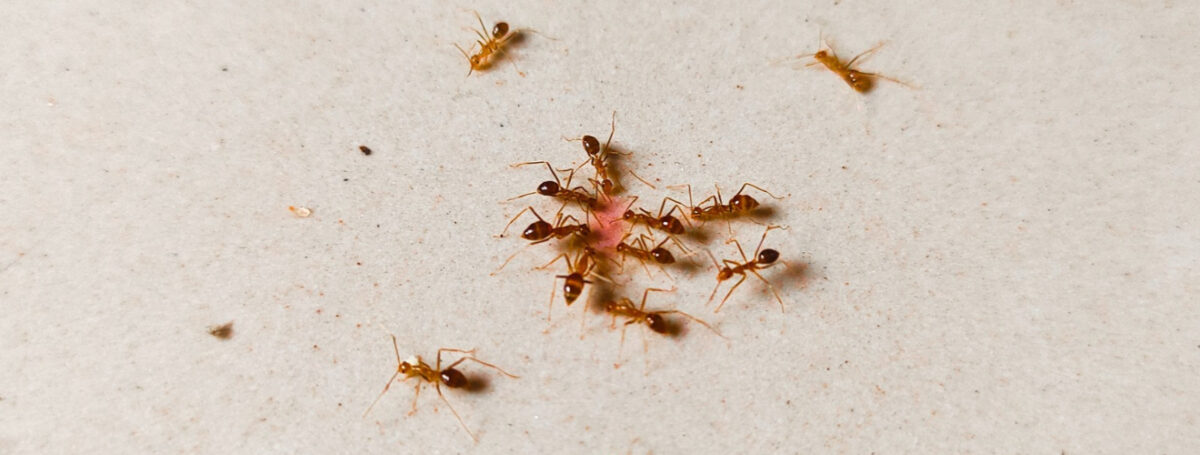
Crazy ants are difficult to control because they live in huge, connected colonies with many queens spread across many nests. When one nest is treated, the others keep producing workers, and ants from nearby areas quickly move back in. For homeowners in New Iberia and across South Louisiana, that can mean thousands of ants in the yard, along the foundation, and inside the house even after several rounds of store-bought products. At Dave’s and Kevin’s Pest Control, our pest control service includes ant treatments built for this kind of problem. Here is what makes crazy ants different and what it takes to bring them under control.
Which Crazy Ants Are in South Louisiana
The name “crazy ant” comes from the fast, jerky way these ants run. They move quickly in what looks like random directions, which sets them apart from ants that travel in neat, single-file lines.
Two types are found in South Louisiana. The longhorn crazy ant is a small, dark ant with long legs and long antennae. It has been around the state for many years and often shows up indoors near food. The tawny crazy ant is a newer, invasive species that has been reported in Lafayette Parish and other parts of South Louisiana, and it is expected to keep spreading across the southern half of the state. Tawny crazy ants are reddish-brown and very small, and they can build up to extremely large numbers on a single property.
Identifying the species takes a trained eye. Several crazy ant species look nearly identical to the naked eye, and a professional identification helps our technicians choose the treatment approach that will work best.
What Makes Tawny Crazy Ants So Hard to Manage
Most ants that homeowners deal with live in a single colony with one queen or a few queens. Tawny crazy ants are different. They form what are called supercolonies, which are very large networks of nests that cooperate with each other instead of fighting. A single supercolony can contain many queens and millions of workers spread across several yards.
This structure is the main reason crazy ants are so difficult to control. Treating a nest near your porch does not affect the nests under your neighbor’s shed or in the wooded area behind your fence. Ants from those untreated nests move into the treated area to replace the ones that were killed. Homeowners often see a drop in the number of ants for a few days, followed by just as many ants as before.
Crazy ants nest under leaf litter, mulch, landscape timbers, rocks, potted plants, and debris, and they can nest inside walls. They build no mounds the way fire ants do. Because the nests are scattered and hidden, there is no single spot to treat.
Why Store-Bought Products Fall Short
Many over-the-counter ant products are designed for fire ant mounds or for small colonies of household ants. They are not built for a problem spread across an entire property. Repellent sprays may move ants away from one area for a short time, but the colony survives and returns.
Baits can also be less effective with crazy ants than with other species. The sheer number of workers means a small amount of bait gets used up quickly, long before it reaches enough of the colony. In heavily infested areas, dead ants can pile up on treated surfaces, and live ants simply walk across the dead ones without contacting the product underneath.
Crazy Ants and Electrical Equipment
Tawny crazy ants are known for gathering inside electrical equipment. They can build up inside air conditioning units, electrical boxes, outdoor outlets, and pool equipment. When large numbers of ants collect around electrical contacts, they can cause short circuits and equipment failure. If your air conditioner or other outdoor equipment stops working during a crazy ant problem, ants may be part of the cause.
How Crazy Ants Spread to New Properties
Tawny crazy ants spread to new properties mainly because people move them, usually without knowing it. Ants travel in potted plants, bags of mulch or soil, landscaping materials, firewood, and items stored outside, such as boats or campers. Once they arrive on a property, the colony spreads outward on foot from there.
This is why New Iberia homeowners should look closely at plants and landscaping materials before bringing them home, especially when they come from an area with a known crazy ant problem.
What It Takes to Control Crazy Ants
Controlling crazy ants takes a planned approach rather than a single treatment. A technician first inspects the property to find where the ants are nesting, traveling, and getting inside. From there, treatments are applied around the foundation, in nesting areas, and along the routes the ants use. Because crazy ants keep moving in from surrounding areas, repeated treatments are usually needed through the warm months to keep the population down.
Changes around the property help those treatments work. Removing leaf litter, piles of debris, and unused items from the yard takes away nesting spots. Pulling mulch back from the foundation and fixing moisture problems makes the area around the house less attractive. These steps support professional treatment, but they do not replace it.
Crazy ants are a serious problem, and they tend to get worse when they are left alone. If you are seeing large numbers of fast-moving ants around your New Iberia home, our team can inspect the property and set up a treatment plan that fits what we find. Contact Dave’s and Kevin’s Pest Control to schedule your free inspection.